

Tag: False Alarms

Why physical security teams struggle with multiple systems in SOC management platforms

Picture your security operations center (SOC).

Your SOC gets an incoming alarm through your access control platform. An operator receives it and switches to the VMS to pull video, navigating to the right cameras and time stamp. Then flips back to the access control system to check the badge log. Then opens a third platform to log the incident and check SOPs for a phone number. Then a fourth to notify the on-call guard. Then a spreadsheet to track response time.

By the time the full picture is assembled, several minutes have passed. In security operations, where moments matter, this can be an eternity. And when alerts are coming in that are false, consuming an operator’s time, these critical incidents might even get missed among the noise (which is a real problem).

This is the reality for most physical security teams today; and it’s not because they haven’t invested in good technology, but because that technology was never designed to work in combination with one another.

Why are physical security teams managing so many disparate systems?

The average SOC operator uses 4.7 different applications in a single shift. At organizations with more than 10 locations, that climbs to 5.6. That’s according to our 2026 State of Physical Security Operations benchmark study, which surveyed 300 security professionals across mid-to-large U.S. enterprises.

Every time an operator switches applications, they are trying to get more context on the security incident. They manually reconstruct timelines that should be automatically compiled for them. They copy data between tools (a task that 19% of respondents said they’d eliminate first). The work of connecting the dots falls on the operators, not the systems.

Here’s the uncomfortable truth: most physical security stacks weren’t built. They accumulated.

An organization deploys access control from one vendor. Cameras from another. They add a visitor management system. A guard tour platform. An incident reporting tool. Each of these decisions made sense in isolation. Each vendor had the best product in its category at the time.

But nobody asked how the data would flow between them.

Security operations management didn’t create this problem, but they are tasked with managing it. 

Why disparate systems are so hard to connect

Legacy physical security systems weren’t designed for integration with other products. They were designed to do one thing well: control access to a door, record video, identify water intrusion. The idea that all of this data might need to live in one place, talk to each other in real time, and surface actionable intelligence for an operator was, frankly, an afterthought.

Proprietary products that don’t “play well with others” (i.e. integrate easily) can mean that operators are forced to tab back and forth between multiple systems without being able to gain a full view of what’s happening. 

The result is what security teams deal with every day: systems that technically work but operationally don’t. Data that exists but isn’t connected. Insights that are possible in theory but impossible to extract in practice without a team of people manually bridging the gap.

The disparate systems problem is bigger than it looks

As organizations grow, the problem compounds fast.

HiveWatch’s research found that as an organization roughly doubles in headcount, the number of connected devices it monitors more than quadruples: from an average of 447 devices to 1,798. Daily alarm volume climbs from 293 to 421+. And the false alarm rate jumps from 29% to 44%.

The cost of this can skyrocket if not addressed. For example, the average hourly rate for an operator is between $19 and $25 per hour. Spending 50% of their time can mean losing $19k to $26k a year on looking at things that don’t matter. Multiply by multiple people per shift and you have quite the resource drain on your hands. 

That means larger organizations are processing over 100 false alarms per day before finding a single real incident. Operators are managing thousands of devices, sifting through hundreds of alarms, across multiple platforms, and expected to not miss anything.

The tools haven’t kept pace with the growth. The humans are absorbing the difference.

This is how false alarms become a massive problem for security operations. It’s not just about the cost of chasing bad alerts – though that’s real, with industrywide false alarms costing the U.S. emergency response system an estimated $3.1 billion annually. It’s about what false alarms prevent: the ability of operators to respond quickly and confidently to actual problems.

When your GSOC is juggling five screens to triage and respond to a single alarm, a real incident is waiting in the queue . The real incident doesn’t announce itself as real, you have to wade through many to find it.

Why finding the right technology that brings systems together is tough

What a modern SOC needs is a true operational layer: something that doesn’t just collect data from disparate systems, but normalizes it, connects it in the right way, and surfaces it in a single place that an operator can easily see and act on.

That’s a fundamental engineering challenge that requires deep knowledge of all of the systems and platforms. The challenge can be amplified by vendors that aren’t truly open or willing to integrate with other systems. Solving this challenge requires that someone have the ability to handle different data schemas, alarm or alert structures, and formats across vendors that have been in the market for decades. 

It requires, frankly, a lot of unglamorous work that most companies find hard to fix. Most physcial security teams don’t have IT resources dedicated to help optimize their tools, and contracting with the people who deployed the systems can be cost prohibitive.

The promise of “unified security management” has been made many times. Usually what gets delivered is a dashboard that aggregates information but doesn’t actually allow operators to see everything they need to see and ACT within a single platform. Operators still have to context-switch. They’re just doing it in slightly fewer tabs. 

There’s also the loss of critical data being collected from these systems, where it can help paint the picture of a security program and how it works from day to day. 

The 56% of security programs stuck at maturity Level 2 or Level 3 in our benchmark research, where processes exist but aren’t consistently followed and technology is deployed but not optimized, aren’t stuck there because they haven’t tried. They’re stuck because they’ve paid for systems that look connected on paper, but fall apart when things get busy. 

There’s a better way to run this

You bought good physical security tools. The problem isn’t the tools. The problem is that they aren’t connected.

You don’t need to replace your ACS, your VMS, or your guard management platform. HiveWatch sits on top of the systems you already have: your cameras, access control, alarm systems, and pulls everything into one screen. Instead of jumping between six tools, an operator sees a single feed of what’s happening right now, already sorted by what matters most. When a door forced-open alarm comes in, they don’t just get the alert, they get the nearby camera footage, who badged in last, and how to respond for that site, all in one place. Routine false alarms get resolved automatically before anyone has to look at them, so the alerts that reach a human are the ones that actually need one.

One incident queue. No more tab switching.

If your security operations team is still stitching together a picture of what happened from five different screens at 2 a.m., the problem isn’t their effort. 

It’s a problem that can be easily solved.

Want to see how leading security programs have unified their systems and improved  operations? See the HiveWatch platform →

Or download the full 2026 State of Physical Security Operations benchmark study to see how your program stacks up.
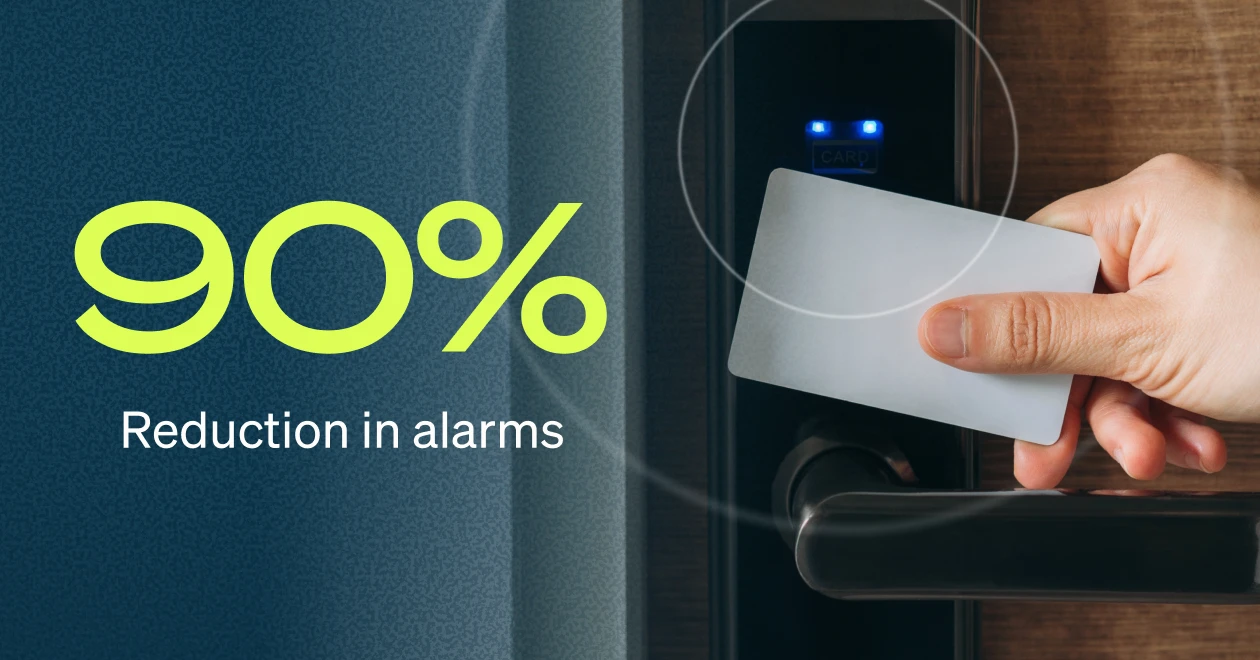
How to Reduce Physical Security False Alarms by 90%

Quick Answer: Security teams can reduce false alarms by roughly 90% through intelligent noise reduction strategies that combine machine learning, alarm deduplication, and AI-powered verification systems. This approach analyzes your specific alarm patterns, consolidates duplicate alerts, and uses video analytics to verify real threats before escalating to human operators.

If you’re managing a security operations center (SOC), you know the drill. Your operators are drowning in alarms, but most of them are likely false. Maybe it’s the wind triggering motion sensors again. Or that same faulty door sensor that’s been acting up for weeks. Whatever the cause, your team is burning out from chasing ghosts instead of catching real threats.

You’re not alone. Security teams everywhere face this exact problem, and it’s getting worse as facilities add more sensors and cameras. But there’s good news: organizations are actually achieving over 90% reduction in false alarms.

Why Would Anyone Hack a Door Lock?

Because it’s easier than you think, and the payoff is real.

Remember the casino that got breached through a connected fish tank thermometer? Once attackers were inside the network, they moved laterally until they found what they wanted. Physical security devices work the same way. An IP camera with default credentials or an access control system running outdated firmware becomes the entry point.

The thing is, most organizations treat physical security systems like appliances. You install them, they work, and then you forget about them. Meanwhile, your IT team is patching servers and rotating credentials monthly. That disconnect is exactly what attackers count on.

The Real Cost of False Alarms (it’s Worse Than You Think)

More false alarms mean security teams pay less attention, making it easier for real threats to go unnoticed. It also requires you to add additional headcount to get to “alarm zero” across all of your security systems. One organization determined they would need six times the number of operators they currently had per day to respond to all incoming alarms as they scaled. Think about what that means:

  • Your operators spend most of their shift clearing nuisance alarms
  • Real security incidents get buried in the noise
  • Alarm fatigue sets in, leading to missed security incidents
  • High turnover rates wreak havoc; some positions see 100% to 300% turnover annually

Why Traditional Approaches Keep Failing

Most security teams try the same old fixes: tweaking sensor sensitivity, adding more operators, or just accepting the chaos. But these band-aid solutions miss the root problem.

Common sources of false alarms include sensors not lining up, broken hardware, environmental factors like wind or rain, shadows at different times of day, animals being mistaken as humans, and even janitorial staff pushing on doors to clean them. You can’t fix all these issues by adjusting a few settings.

The 90% Solution: A Three-Part Strategy

1. Intelligent Deduplication

The first step is dealing with duplicate alarms. Think about a “door forced” alarm where more than 30 alerts are created over 10 seconds for a single security incident. There’s only one actual event, but operators have to close out all these alarms.

Modern platforms consolidate these duplicates into a single signal. This alone can cut your alarm volume by 50% or more, depending on your setup.

Implementation tip: Start by analyzing your alarm data to identify which devices generate the most duplicates or ratios between door open events and door forced alarms. Focus your deduplication efforts there first for maximum impact.

2. Machine Learning Pattern Recognition

Machine learning can dramatically reduce false alarms and excess noise by up to 90%. But not through some magical black box—it works by learning your specific security program dynamics.

The system analyzes:

  • Which alarms typically turn out to be false
  • Patterns in timing and location
  • Environmental conditions when false alarms occur
  • Historical data from your specific devices

Over time, it gets scary good at predicting which alarms are real threats versus noise.

Real-world result: One organization reduced alarms on a single device from 305 per week down to just 25 – a 91% monthly noise reduction.

3. AI-Powered Verification

Here’s the game-changer: using AI to verify alarms before they reach human operators. The AI Operator can verify alarms by reviewing camera footage, add notes to incidents, resolve incidents, and only escalate high-priority events to human supervisors.

Instead of your team investigating every single alert, the AI pre-screens them:

  • Motion detected? AI checks the camera feed
  • Door forced alarm? AI verifies if someone actually entered
  • Tailgating alert? AI confirms multiple people passed through

Only verified threats make it to your operators’ screens.

Getting Started: Your 30-Day Roadmap

Ready to cut your false alarms by 90%? Here’s your action plan:

Week 1-2: Baseline Analysis

  • Document your current alarm volume and types
  • Identify your top 10 noise generators
  • Calculate how much time operators spend on addressing the false alarms

Week 2-3: Implement Quick Wins

  • Set up deduplication for your noisiest devices
  • Adjust obvious environmental triggers (like that tree branch hitting the fence)
  • Create alarm suppression rules for known false positive scenarios

Week 3-4: Deploy Intelligent Solutions

  • Implement ML-based alarm filtering
  • Set up AI verification for high-volume alarm types
  • Train the system on your specific patterns

Week 4+: Optimize and Scale

  • Monitor reduction percentages
  • Fine-tune based on results
  • Expand to additional alarm types

Measuring Success

Track these metrics to prove your progress:

  • Total alarm volume (before vs. after)
  • Percentage of alarms requiring human investigation
  • Average operator response time
  • Missed incidents (should decrease as operators focus on real threats)

After implementing noise reduction strategies, GSOC operators can become 57% more efficient, shifting from primarily reactive to a more proactive approach.

Beyond False Alarms: The Bigger Picture

When you reduce false alarms by 90%, something amazing happens. Your security team transforms from alarm chasers to strategic thinkers. They have time to:

  • Conduct proactive threat assessments
  • Improve security procedures
  • Build relationships with other departments
  • Focus on business continuity planning

Physical security done right produces ROI, as teams can focus on high-value, complex strategic initiatives like business continuity and supply chain resilience instead of alarm-chasing.

Common Objections (and Why They’re Wrong)

“AI will replace our security staff.” Wrong. The AI Operator isn’t a replacement for sophisticated operators, but should be thought of as an assistant that never sleeps or takes a coffee break. Your team gets elevated, not eliminated.

“Our facility is too unique.” No two security programs are identical, so noise reduction approaches should be flexible and empower teams to drive their own noise reduction program. Modern solutions adapt to your specific needs.

“It’s too expensive.” Consider this: reducing false alarms by 90% is like multiplying your team size by 10, without the salary costs. The ROI typically appears within months, not years.

Your Next Step

False alarms aren’t just an annoyance; they’re a critical vulnerability in your security program. Every moment your team spends on noise is a moment they’re not protecting what matters.

The technology exists today to achieve 90% false alarm reduction. The question isn’t whether you can do it, but how quickly you can get started.

Ready to see what 90% fewer false alarms looks like for your organization? Learn more about HiveWatch’s approach to noise reduction or explore how AI-powered verification works.

Reducing Noise the Right Way

“Noise” in a global security operations center (GSOC) refers to the numerous alarms coming in for operators to analyze and address. Amongst this “noise” are legitimate security alerts that need to be addressed immediately, crowded by completely false alarms triggered by faulty sensors, environmental factors (wind, rain, animals), and user error. When left unaddressed this noise problem can result in system overload, compromised security, high operator turnover, and complacency.  That’s why noise reduction is critical for every GSOC.

Reducing Noise in Security Operations Centers

For so many of us, the picture in our minds when we discuss security operations centers or command centers is the photo of numerous operators with multiple screens, a massive video wall and a chaotic response happening in real-time. The reality for the majority of businesses is a bit different; however, there is still an element of chaos in many SOCs that can give rise to confusion and misinformation.